
In a Market Flooded With Flat Prints and AI Art, Sculptor Natasha Kanevski Bets Big on Handmade Depth With Stunning Stone Clay Wall Sculptures
As artificial intelligence reshapes the art world and mass-produced prints saturate the home decor market, sculptor Natasha Kanevski offers a bold alternative with handcrafted 3D wall sculptures made from stone clay. Her work, featured at New York exhibition, museum show, and international art fairs, delivers a tactile, dimensional experience that no screen or printer can replicate.
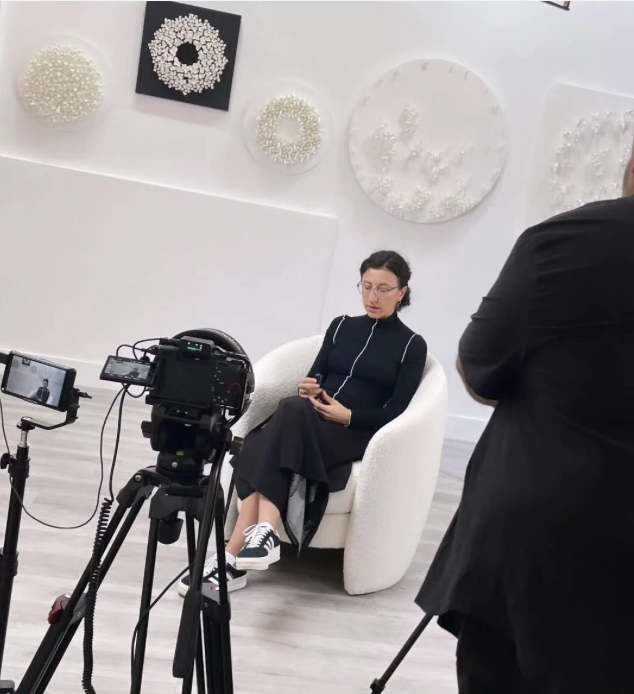
The contemporary art and home decor markets are experiencing a tension that has been building for years. On one side, artificial intelligence tools now generate images in seconds, and affordable print-on-demand services can fill any wall with color and pattern at minimal cost. On the other, a growing segment of collectors and homeowners is actively seeking the opposite: original, handmade, physically present works of art that no algorithm can duplicate. Sculptor Natasha Kanevski is positioned squarely on the handmade side of that divide, and demand for her distinctive stone clay wall sculptures is reflecting the shift.
Kanevski's work stands apart from conventional wall art in the most fundamental way possible. Her wall sculptures are fully three-dimensional, composed of hundreds of individually hand-formed elements in stone clay that are assembled into large-scale compositions (or tiny ones) with the visual complexity of natural phenomena. The finished pieces evoke coral formations, flowering hedgerows, and wind-shaped landscapes, yet they remain entirely abstract. What consistently surprises viewers is the material itself. Stone clay, which carries real density and durability, is shaped into forms so thin and precisely curved that they appear to be made of paper. The visual effect is one of impossible delicacy, a quality that draws people in and makes them hesitate to touch even as their hands instinctively reach forward.
The sculptures are not produced quickly. Each piece requires an extended period of focused, repetitive handwork as Kanevski shapes individual forms one at a time before composing them into a unified whole. This process is fueled by a cognitive characteristic she discusses openly. As a person with autistic traits, Kanevski experiences the repetitive sculpting process not as tedium but as a state of deep, joyful focus. That sustained attention is what allows her to maintain the precision and consistency necessary across hundreds of forms, producing textures of a density and intricacy that would be difficult to achieve through any other means.
Her professional record underscores the caliber of the work. A solo exhibition in New York gave collectors and critics an immersive encounter with her sculptural walls, and a museum exhibit brought her practice to an institutional audience. International art fairs and gallery presentations continue to be her primary exhibition venues, placing her alongside established contemporary artists and giving her work visibility in markets where serious collectors are actively looking for the next distinctive voice.
Kanevski has also chosen to sell directly through Etsy, a decision that reflects her interest in reaching buyers outside the traditional gallery framework. Rather than relying solely on curators and gallery directors to determine who encounters her work, she uses the online platform to connect with design professionals, luxury homeowners, and art enthusiasts who might discover her sculptures while searching for something genuinely original to anchor a room.
Her target audience is specific and growing. These are people who invest thoughtfully in their living spaces and who recognize the difference between decoration and art. They want a piece that prompts guests to stop, approach, and ask questions. They want shadows that shift throughout the day, surfaces that reveal new details on the tenth viewing, and the knowledge that what hangs on their wall was made entirely by human hands over many hours of careful work.
As the cultural conversation around AI-generated content intensifies and consumers become more discerning about authenticity, artists like Kanevski who work in irreducibly physical media occupy an increasingly valuable position. Her sculptures cannot be prompted into existence. They cannot be reproduced by a printer. They exist as singular objects that carry the full weight of material, process, and human attention, and in a market that is rapidly flattening, that depth is exactly what discerning buyers are looking for.
CONTACT: https://www.artbynatashakanevski.com
https://instagram.com/art.by.natasha.kanevski