
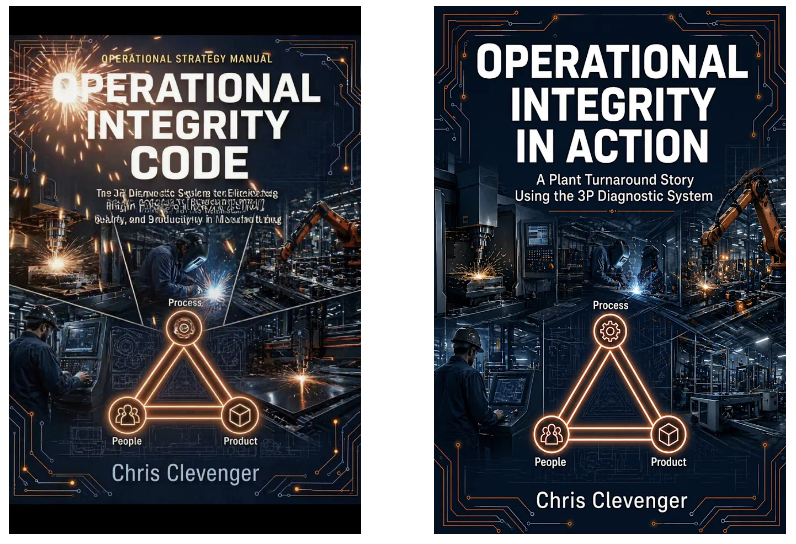
San Antonio, Texas, USA – August 19, 2026 – Manufacturing operations leader and author Chris Clevenger has launched the Operational Integrity Series, a two-book manufacturing leadership series built from more than 30 years of experience leading, improving, and rebuilding industrial operations under real operating pressure. The launch is supported by a new author website at chris-clevenger.author-pages.com, providing a central resource for readers interested in manufacturing leadership, operational excellence, safety, quality, productivity, and lasting plant performance.
The series begins with Operational Integrity Code: The 3P Diagnostic System for Eliminating Hidden Failure and Restoring Safety, Quality, and Productivity in Manufacturing. The nonfiction book serves as the doctrine and technical foundation of the series. It introduces the 3P Diagnostic System, which examines the interaction between People, Process, and Product to help leaders identify the structural conditions behind recurring operational problems.
Its companion book, Operational Integrity in Action, takes those same principles into a fictional manufacturing plant turnaround. Through the story of Ridgeway Trailer Manufacturing and Plant Manager Daniel Mercer, readers see how the concepts from the doctrine can be applied through shop-floor observation, leadership decisions, safety corrections, quality controls, process redesign, accountability, workforce development, and the daily pressures of running a manufacturing operation.
“The first book explains the system,” Clevenger said. “The second allows the reader to walk through a plant and see the system being applied.”
At the center of the Operational Integrity approach is the belief that recurring manufacturing problems rarely exist in isolation. People respond to the processes around them. Weak processes influence product outcomes. Product problems create additional pressure on the people trying to maintain production. When those conditions continue long enough, workarounds become accepted, instability becomes harder to recognize, and organizations can become better at managing symptoms than correcting causes.
Clevenger describes these embedded weaknesses as Hidden Failure Nodes. They may appear as an unclear handoff, an unreliable process, an undocumented adjustment known only by an experienced employee, a recurring quality problem, a safety exposure that has become normalized, or another condition that people have learned to work around simply to keep production moving.
The 3P Diagnostic System is designed to help leaders identify those conditions across People, Process, and Product and ask a more direct question: What inside the system is allowing this problem to repeat?
Another central principle carried throughout both books is Clevenger’s operating sequence of Safety First, Quality Second, and Productivity Last. The philosophy does not minimize productivity. Instead, it reflects his view that sustainable productivity depends on first creating an operation where people can work safely and processes can consistently produce quality results. When safety and quality become unstable, productivity eventually becomes unstable as well.
The Operational Integrity Series grew from a much more personal beginning.
In 2023, Clevenger underwent brain surgery after a life-threatening condition was discovered. During his recovery, he began thinking about decades of leadership notes, training materials, operational assessments, turnaround methods, process-improvement ideas, and lessons learned that existed across scattered documents and personal experience.
His original goal was simply to organize that knowledge into a form others could use.
As the material developed, one book became two books, and the two books became the foundation of a larger series.
Much of the writing took place during the early morning hours before Clevenger left for work. Over approximately two and a half years, he spent roughly 1,800 hours writing, reviewing, researching, and organizing the material, often beginning between 2:30 and 3:00 in the morning while standing at the kitchen bar in his Texas home.
The experience strengthened a belief that became central to the purpose of the series: knowledge left undocumented is eventually lost.
Rather than presenting manufacturing leadership only through theory, the Operational Integrity Series is grounded in conditions Clevenger has encountered throughout his career—unstable schedules, safety shortcuts, rework, late quality detection, unclear handoffs, equipment problems, low labor utilization, weak accountability, poor morale, and departments struggling to work as one connected system.
The books are intended for plant managers, operations leaders, supervisors, quality professionals, safety leaders, maintenance teams, engineers, continuous improvement professionals, business owners, and others responsible for making manufacturing systems perform under real pressure.
The newly launched author website provides readers with information about both books, the Operational Integrity Series, Clevenger’s background, and the concepts behind the 3P Diagnostic System and Hidden Failure Nodes. It also serves as a central point for future additions to the series as the work expands into deeper areas of manufacturing leadership, operational diagnosis, organizational reality, and lasting system improvement.
For Clevenger, the launch represents more than becoming a published author. It is an effort to preserve decades of hard-earned manufacturing knowledge and make it useful to the next generation of leaders.
What began as an effort to organize old notes became a book. The book became two books. And the two books became the beginning of the Operational Integrity Series.
About Us
PIVOT Operational Solutions, founded by Chris Clevenger, is dedicated to helping manufacturing leaders improve operational stability, safety, quality, and productivity through practical, experience-driven frameworks. Based in San Antonio, Texas, the company supports plant managers, operations executives, supervisors, and continuous improvement professionals across the manufacturing industry through the Operational Integrity Series and related resources.
CONTACT: https://chris-clevenger.author-pages.com/
https://www.linkedin.com/in/chrisclevenger/
https://www.facebook.com/cclev1971/
https://www.linkedin.com/company/pivot-operational-solutions/
This sponsored dispatch was supplied and paid for by PIVOT Operational Solutions. Its claims are the submitter's own, not TV Houston 67's.